Resource Pools
Feature Overview
| Item | Content |
|---|---|
| Applicable Roles | Operators |
| Navigation Path | AI Infra(On-Cloud) > Access Management > Resource Pools |
| Page Route | /infrahub/op/access/region |
| Managed Objects | Regional resource pools under cloud platforms and their enabled states |
Beginner Explanation
Resource Pools controls whether cloud regions are available. Enabled pools can enter authorization and scheduling scopes; disabling affects deployment choices.
Terminology
| Term | Description |
|---|---|
| Resource Pool | An available resource scope organized by cloud platform and region. |
| Enabled State | Whether a pool can enter authorization and scheduling workflows. |
| Enabled Only | A filter that shows only enabled pools. |
Recommended Operation Order
Select a cloud platform and review its pools, assess authorization and deployment impact, then change the target state and verify downstream visibility.
Beginner Checklist
| Scenario | Do First | Do Not Do Directly |
|---|---|---|
| First visit | Review existing objects, states, and available actions | Change an unknown object |
| Before a change | Verify upstream dependencies, impact scope, and target object | Skip dependency and impact checks |
| After completion | Validate the current and downstream pages with Result Validation | Rely only on a success message |
| Page error | Record the redacted object, time, and page message | Submit repeatedly or record real credentials |
Prerequisites
- The current account has the permission required for Resource Pools.
- The target cloud platform is connected and its pool list loads correctly.
- Before changing state, check tenant authorization, business authorization, scheduling policies, and existing deployments.
Page Description
The left side lists cloud platforms; the right side shows regional pools and state switches for the selected platform.
Page screenshots:
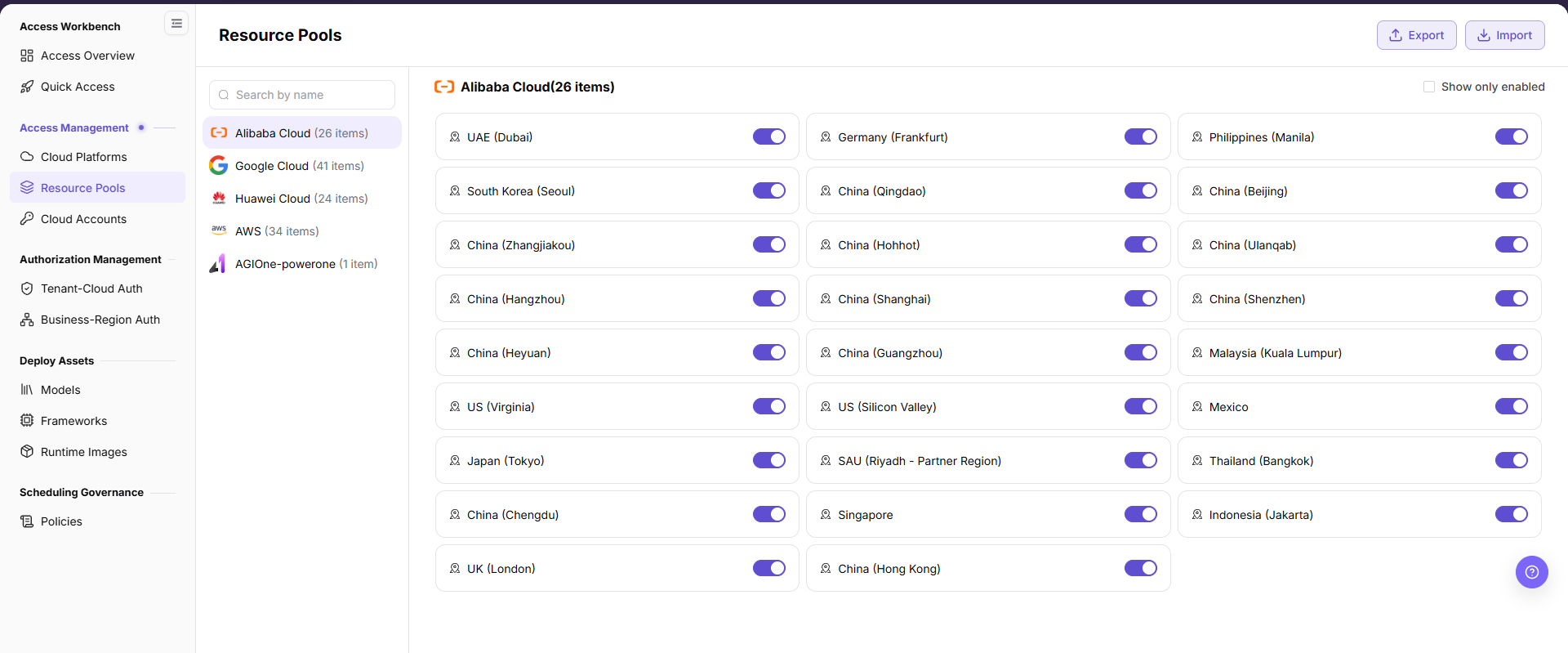
The image shows the Resource Pools management page, with connected cloud platforms listed on the left and corresponding regional resource pools with enable/disable toggles on the right.
Main Operations
View Resource Pools
- Select the target cloud platform on the left.
- Use
Enabled Onlywithin the step when a narrower list is needed. - Verify region names and enabled states.
Enable or Disable Resource Pool
- Locate the target region and confirm its current state.
- Toggle the state switch and read the region and action in the confirmation message.
- Click "Confirm" and refresh the list.
- Verify the expected visibility on authorization and deployment pages.
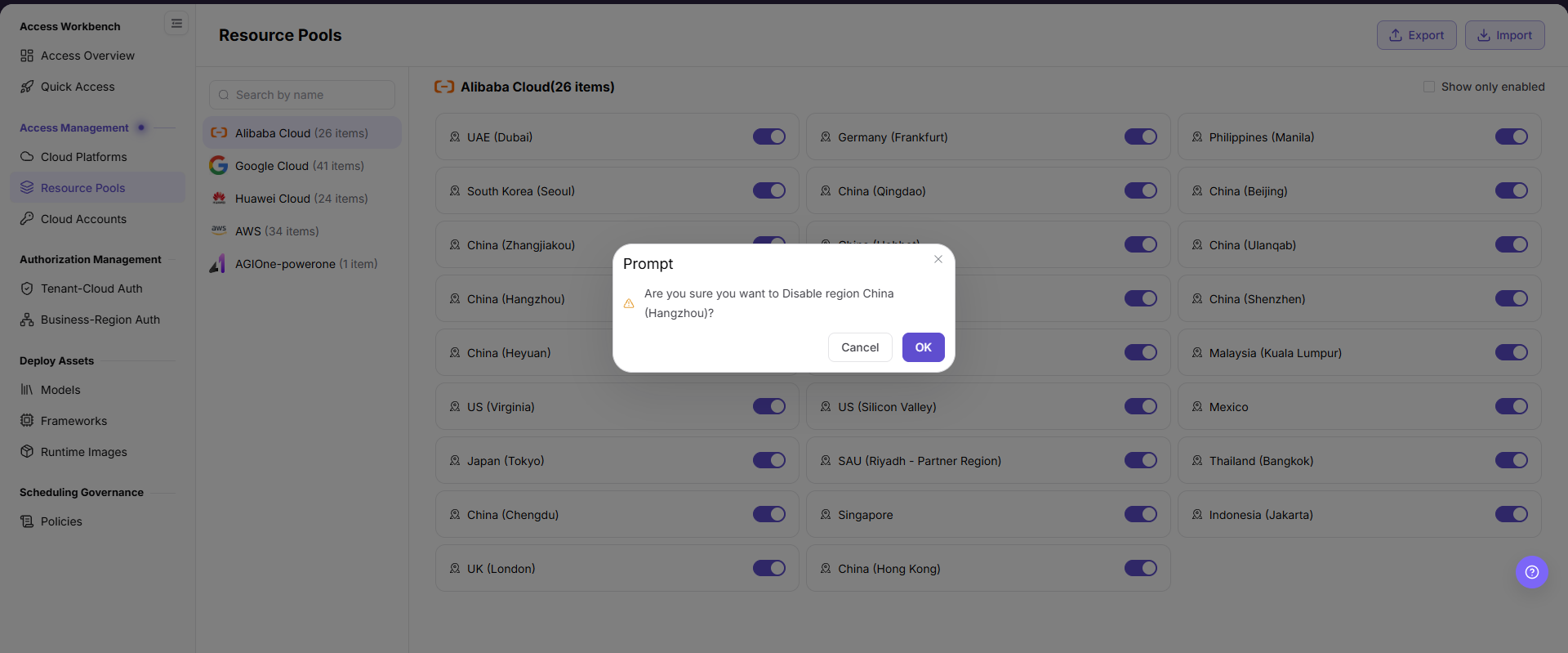
The image shows the secondary confirmation dialog when enabling or disabling a regional resource pool, where you must confirm the target region before proceeding.
Parameter Reference
| Field Name | Required | Field Type | Example | Description |
|---|---|---|---|---|
| Cloud Platform | Yes | List item | Alibaba Cloud | Cloud platform that owns the resource pools. |
| Resource Pool Count | System-generated | Number | 26 items | Number of resource pools under the current cloud platform. |
| Resource Pool Name | System-generated | Text | China (Hangzhou) | Resource pool name displayed by region on the current page. |
| Enabled Status | Yes | Switch | On / Off | Controls whether the resource pool can continue to be authorized, displayed, or scheduled. |
| Show only enabled | No | Checkbox | Selected / unselected | Filters the list to show only enabled resource pools. |
| Name Search | No | Input | Displayed on page | Searches cloud platform or resource pool related entries by name. |
| Import | No | Action button | Import | Imports resource pool related configuration and may affect real configuration. Use with caution. |
| Export | No | Action button | Export | Exports resource pool list or configuration data. Pay attention to sensitive information. |
| Confirmation Prompt | System-generated | Dialog | Are you sure you want to Disable region China (Hangzhou)? | Secondary confirmation shown before enabling or disabling. |
| Cancel | No | Action button | Cancel | Closes the confirmation dialog without applying the change. |
| OK | No | High-risk action | OK | Confirms enabling or disabling the resource pool and applies a real status change. |
Pitfalls
- Do not skip the upstream dependency check: The target cloud platform is connected and its pool list loads correctly.
- Confirm impact before a configuration change: Before changing state, check tenant authorization, business authorization, scheduling policies, and existing deployments.
- A success message does not prove downstream synchronization. Use Result Validation afterward.
- Use only
<API_KEY>,<PERSONAL_KEY>,<ACCESS_KEY_ID>,<ACCESS_KEY_SECRET>,<BASE_URL>, and<ENDPOINT_PATH>for credential and endpoint examples.
Result Validation
| Check Item | Success Signal | If Abnormal |
|---|---|---|
| Page is accessible | Title, navigation, and main content display correctly | Check role permission and navigation path |
| Managed objects are visible | Regional resource pools under cloud platforms and their enabled states display as expected | Clear filters and verify upstream dependencies |
| Operation result is saved | The expected state or new record appears | Review page messages, required fields, and dependencies |
| Downstream result is consistent | Associated pages show the change | Wait for synchronization, refresh, and return to the responsible object |
FAQ
Target Object Is Missing in Resource Pools
Symptom:
The expected object is missing from the list or selector.
Possible Causes:
- Active query criteria filter out the target object.
- An upstream object is disabled, or the current role lacks visibility.
Resolution:
- Clear filters and refresh the page.
- Verify the prerequisite object: The target cloud platform is connected and its pool list loads correctly.
- Confirm the current role and data scope, then locate the object again.
Resource Pools Action Is Unavailable
Symptom:
An expected button, menu, or state switch is unavailable.
Possible Causes:
- The current account lacks the required action permission.
- Object state, references, or prerequisites block the action.
Resolution:
- Verify the permission for the action and the current object state.
- Check references and prerequisites identified by the page message.
- Remove the blocker, refresh the page, and perform the action once.
Resource Pools Change Does Not Reach Downstream
Symptom:
The page reports success, but a downstream page still shows the old state.
Possible Causes:
- An associated page has stale cache or synchronization delay.
- The current and downstream pages use different roles, tenants, or data scopes.
Resolution:
- Wait for synchronization and refresh both pages.
- Confirm that both pages use the same role, tenant, and object scope.
- If they still differ, return to the responsible object and verify the saved result.
Resource Pools Data Differs from Another Page
Symptom:
Counts or states differ from an associated page.
Possible Causes:
- The pages use different filters, aggregation rules, or update times.
- The change is still synchronizing, or role-based data scopes differ.
Resolution:
- Align filters and aggregation rules on both pages.
- Check update times and wait for synchronization.
- Compare object details instead of summary counts only.
How to Troubleshoot a Resource Pools Failure
Symptom:
Submission fails or the state does not change for an extended period.
Possible Causes:
- Required fields, field combinations, or object state do not meet submission rules.
- An upstream dependency is invalid, the request failed, or the same action is already processing.
Resolution:
- Record the redacted object, time, and complete page message.
- Verify required fields, object state, and upstream dependencies.
- Confirm that no identical job is processing before one retry.
Notes
- Before changing state, check tenant authorization, business authorization, scheduling policies, and existing deployments.
- Do not put real accounts, credentials, internal locations, or customer data in documentation, screenshots, tickets, or chat records.
- Authorization, deployment, deletion, publication, state, or billing changes require an auditable record and recovery plan.
Next Steps
- Go to Tenant-Cloud Auth or Business-Region Auth to verify resource pool visibility scope.
- Go to Policies to confirm scheduling rules after enabling or disabling.
- Go to Access Overview to review resource pool status and resource checklist display.