Publish a Model (Speech)
Target Outcome
The speech model passes protocol testing, is published to the intended scope, and returns a playable or decodable audio result.
Applicable Roles
- Model Provider
Before You Start
- Prepare the model source, identifier, API credential, endpoint, and a non-sensitive audio or text sample.
- Confirm language, voice, format, sample rate, synchronous or asynchronous behavior, billing, and limits.
Procedure
- From the platform home page, select My Models in the left navigation.
- Open My Publications. Use Public Models / Private Models to switch publication areas, or open Overview and My Aggregations when needed.
- Select Publish Model in the upper-right corner.
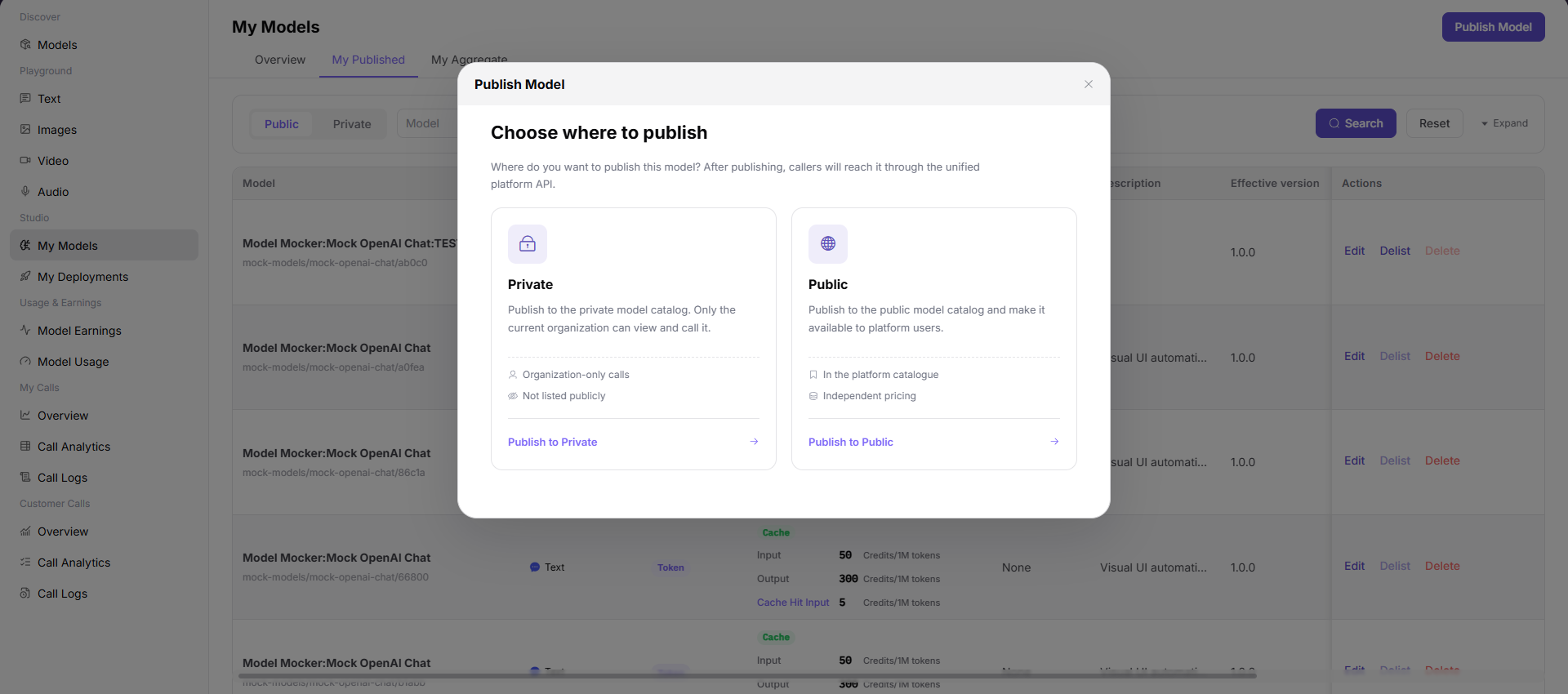
- Select a publication area:
- Publish to Private Area makes the model visible only within the team or tenant and keeps it out of the public catalog.
- Publish to Public Area lists the model in the public catalog for all tenants and allows independent pricing and rate limits.
- Select Publish to Public Area to open Step 1.
Step 1: Basic Information
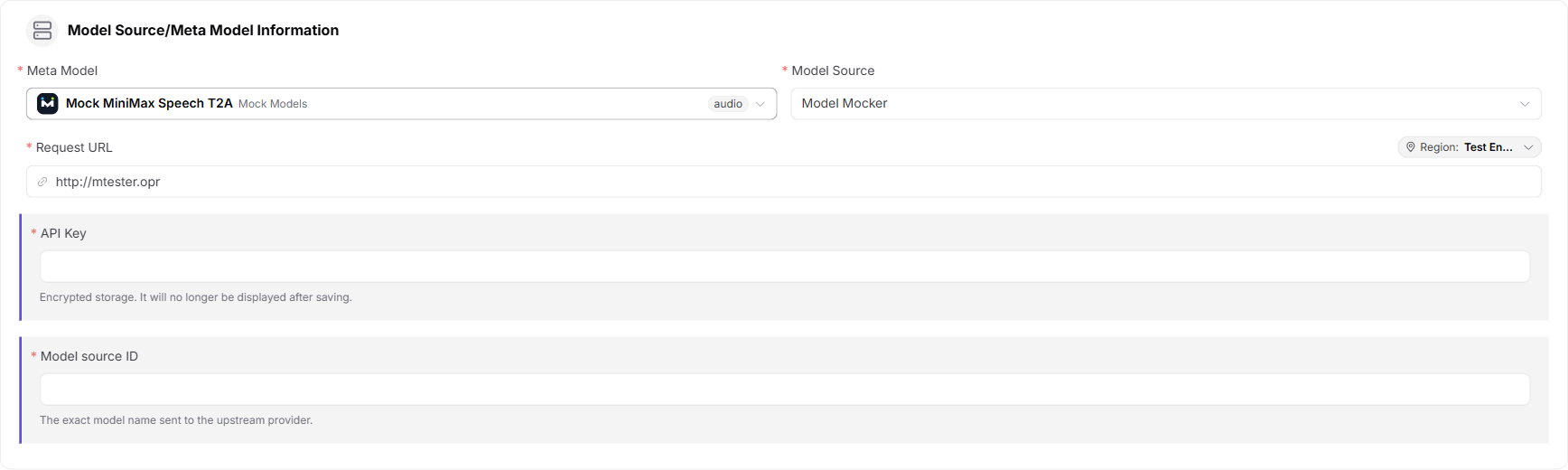
- Under Model Source / Meta-Model Information:
- Select a meta-model, such as
qwen3-tts-flash. - Select a model source, such as Alibaba - China.
- Enter the request URL, such as
https://dashscope.aliyuncs.com. - Enter the API key in the protected field, such as
sk-***. - Enter the exact upstream Model Source ID, such as
qwen3-tts-flash.
- Select a meta-model, such as
- Confirm Speech Model and select the correct subtype, such as Text to Speech.

- Under Request Headers, keep the default
Authorization: Bearer <key>template and add only headers required by the upstream service.

- Under Model Parameters, set the input modality to Text and the output modality to Audio.

- Under Supported Protocols and Default Parameters:
- Select
OpenAI-Audio, run the connectivity test, and enter the endpoint. - Configure inputs such as Text, Voice, Language, Audio Format, Sample Rate, Volume, Speech Rate, Pitch, and Seed.
- Select Synchronous or Asynchronous invocation.
- Configure result parsing with Result Path, URL Extract Field, and Base64 Extract Field.
- Select

- Enter the public Custom Identifier and description.

- Select Publish Immediately or Scheduled Publication.

- Select Next to open Step 2.
Step 2: Billing Configuration
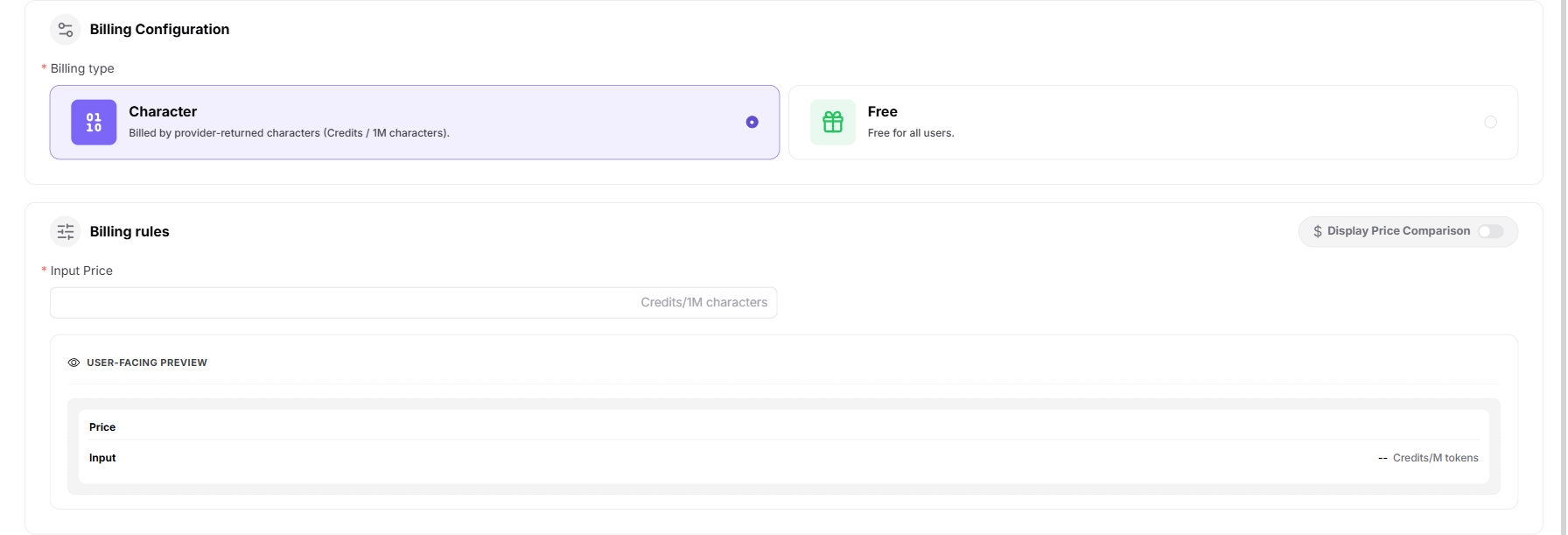
- Select Character Billing or Free.
- For character billing:
- Enable Show Price Comparison when a reference price should be displayed.
- Enter the input sale price and optional original price in Credits per 1M characters.
- Optionally configure a free quota, eligible-user count, and total amount.
- Select Next to open Step 3.
Step 3: Rate-Limit Configuration
- Select Enable Rate Limiting or Disabled.
- Configure default RPM and TPM values, or set either limit to Unlimited.
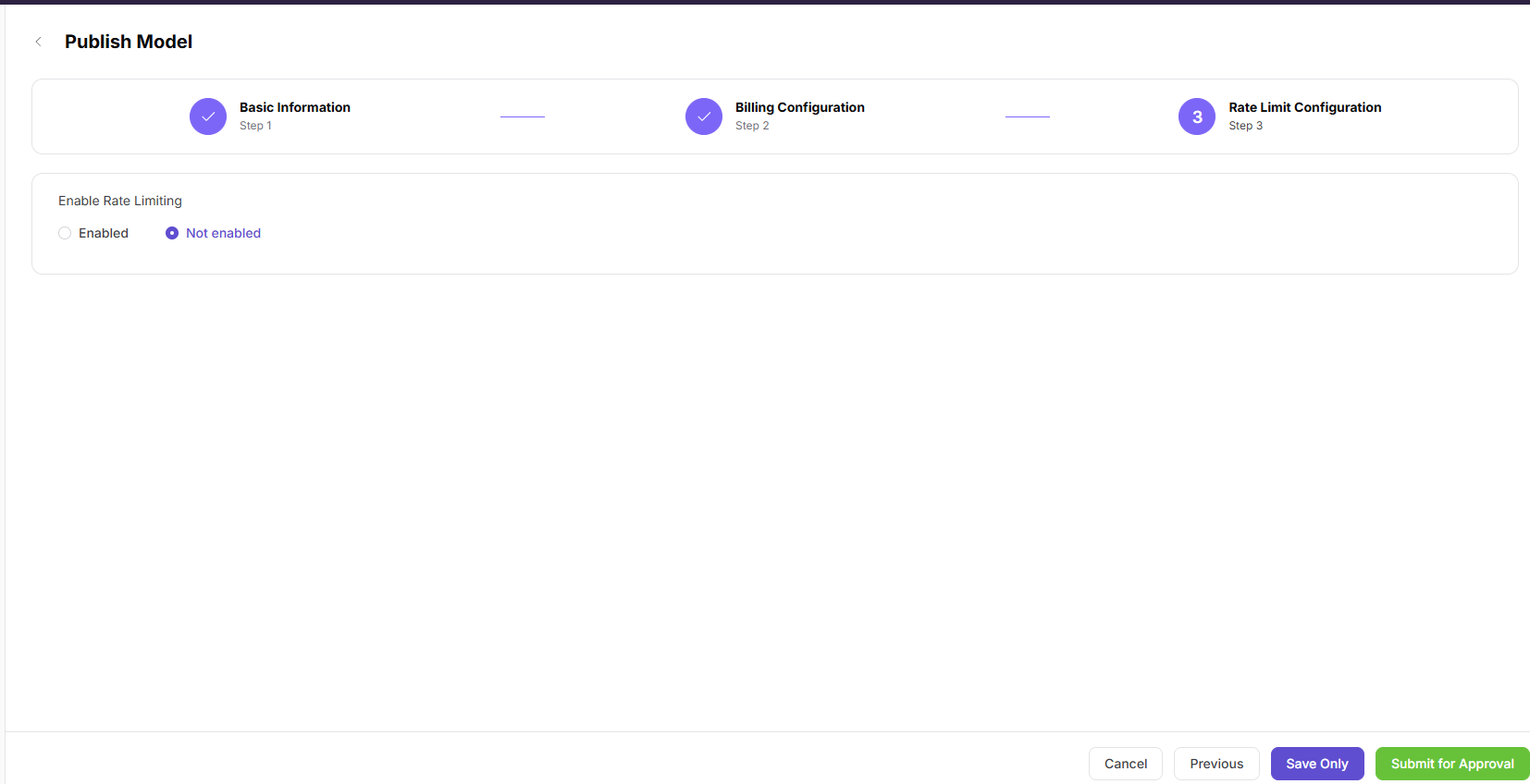
- Select Save Only or Submit for Review.
Parameter Reference - Speech Model
| Field | Type | Example | Description |
|---|---|---|---|
| Meta-Model | Select | qwen3-tts-flash | Required; base meta-model |
| Model Source | Select | Alibaba - China | Required; upstream Model Provider |
| Request URL | URL | https://dashscope.aliyuncs.com | Required; model-service base URL |
| API Key | Password | sk-*** | Required; protected upstream credential |
| Model Source ID | Text | qwen3-tts-flash | Required; exact upstream model name |
| Model Type | Single select | Speech Model | Required; model function |
| Model Subtype | Select | Text to Speech | Required; speech-model subtype |
| Request Headers | Key-value pairs | Authorization: Bearer <key> | Optional; authentication and custom headers |
| Input Modality | Multi-select | Text | Required; accepted input type |
| Output Modality | Multi-select | Audio | Required; result type |
| Supported Protocol | Multi-select | OpenAI-Audio | Required; test connectivity before continuing |
| Endpoint | URL | https://dashscope.aliyuncs.com/api/v1/services/audio/tts/SpeechSynthesizer | Required; protocol endpoint |
| Input Parameters | Parameter list | Text / Voice / Language / Audio Format / Sample Rate / Volume / Speech Rate / Pitch / Seed | Optional; protocol inputs and required-state settings |
| Invocation Method | Single select | Synchronous / Asynchronous | Required; invocation behavior |
| Result Path | Text | data.audio or response.output.results | Optional; path to the result payload |
| URL Extract Field | Text | url or audio_url | Optional; field containing the result URL |
| Base64 Extract Field | Text | b64_audio | Optional; field containing Base64 audio data |
| Custom Identifier | Text | qwen3-tts-flash | Required; model identifier shown to users |
| Description | Text | Text to speech... | Optional; model description |
| Publication Method | Single select | Immediate / Scheduled | Required; publication time |
| Billing Method | Single select | Per Character / Free | Required; billing method |
| Show Price Comparison | Switch | On / Off | Optional; displays an original reference price |
| Input Sale Price | Number | 8 Credits/1M characters | Required for paid models |
| Original Price | Number | 16 Credits/1M characters | Optional; character reference price |
| Free Quota | Switch | On / Off | Optional; configures free usage quota |
| Rate Limiting | Single select | Enabled / Disabled | Optional; controls invocation limits |
| RPM | Number / Unlimited | 2 requests/minute | Optional; request limit per minute |
| TPM | Number / Unlimited | 100 tokens/minute | Optional; token limit per minute |
Completion Checklist
Purpose: These are the exit criteria for the current feature task. Use them to decide whether the result is observable and reviewable and whether you can continue to the next step in the scenario. They do not repeat the procedure; if any item fails, follow the troubleshooting section below.
| Check | Pass Criteria |
|---|---|
| 1 | Protocol connectivity passes and language, voice, and format settings are accurate. |
| 2 | Publication or review status is correct. |
| 3 | A controlled call returns playable audio and the call log is traceable. |
Troubleshooting
| Symptom | Check First |
|---|---|
| Protocol test fails | Endpoint, credential, model identifier, audio encoding, and request body |
| Audio cannot be played | Response mapping, Content-Type, sample rate, format, and result URL |
User Manual
Review complete My Models fields and publication-result validation