Model Usage & Earnings
Callers inspect their consumption; providers inspect income from their own models. The pages have different scopes: total caller consumption is not automatically the provider's revenue. Credit is the platform's pricing unit; a token is a model text-processing unit, so their counts are not interchangeable.
Applicable Roles
- End Users and Model Providers; operators assist when financial investigation is needed.
For handoff, the caller provides the time range and log identifiers; the provider adds effective revisions, prices, and earnings records. The operator takes over unexplained differences. Share only necessary reconciliation information, never credentials.
Before You Start
- Confirm whether this account is a caller or provider, then record model, provider, billing cycle, dates, and unit.
- Prepare a call time or identifier without keys or full request bodies; confirm the active publication revision and price.
Procedure
- Open My Calls logs, narrow by month, model, and client source, and inspect call time, route, caller attribution, usage, and status. Caller attribution is a member/project dimension, not the application-source dimension.
- Open Model Services > Usage & Earnings > Model Usage, align Billing cycle and Date, and read Used Models, Total Consumption (Credit), and Total Token Consumption. Open Usage Details for itemized checks. Do not assume the overview provides Model ID or member/project filters.
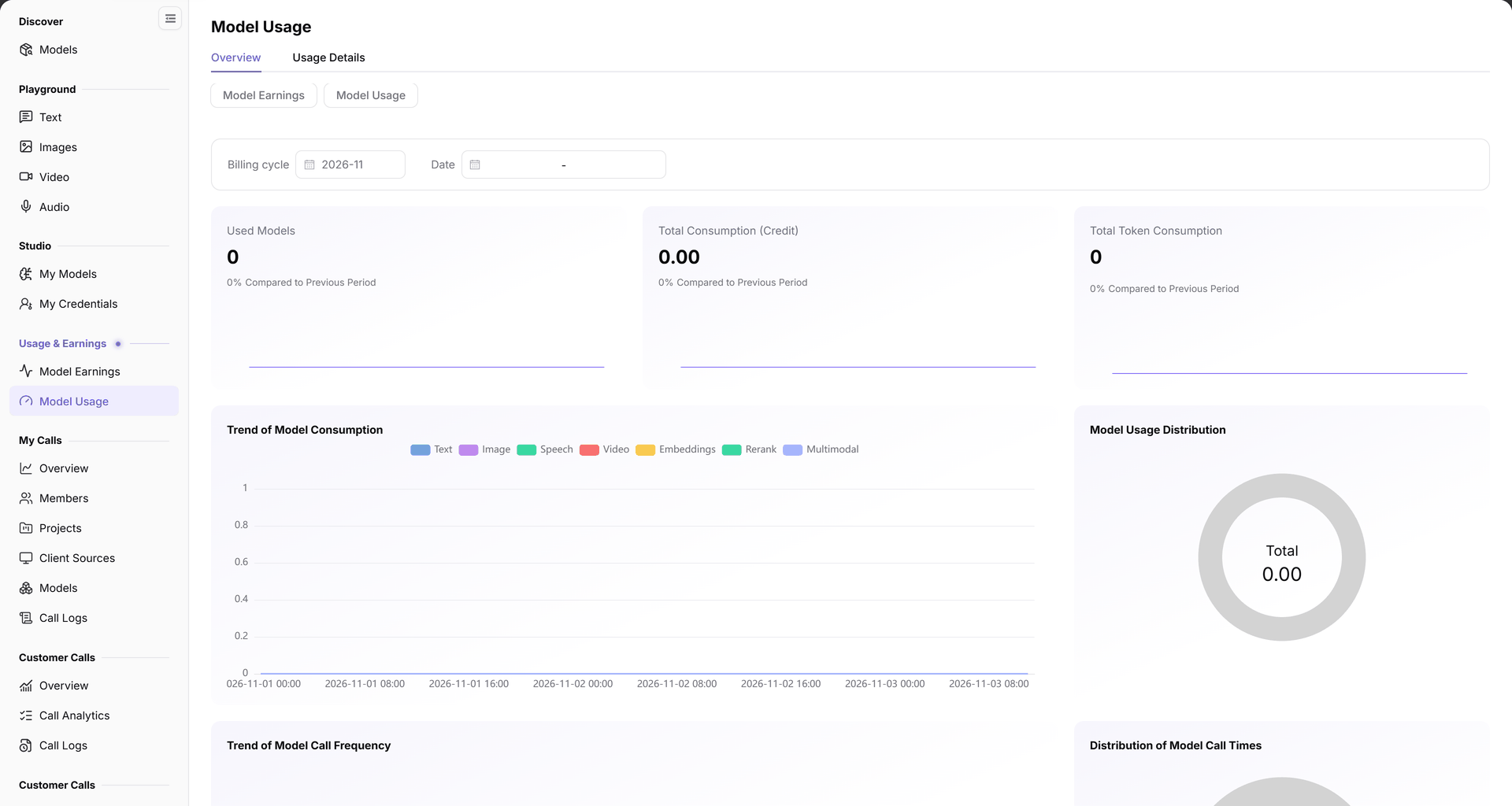
The figure shows consumption metrics and trends for the selected period; it is not a complete bill for an individual request.
- The provider opens Model Services > Usage & Earnings > Model Earnings, aligns cycle and dates, reads tenants, models, income tokens, and credits earned, then opens Earning Details.
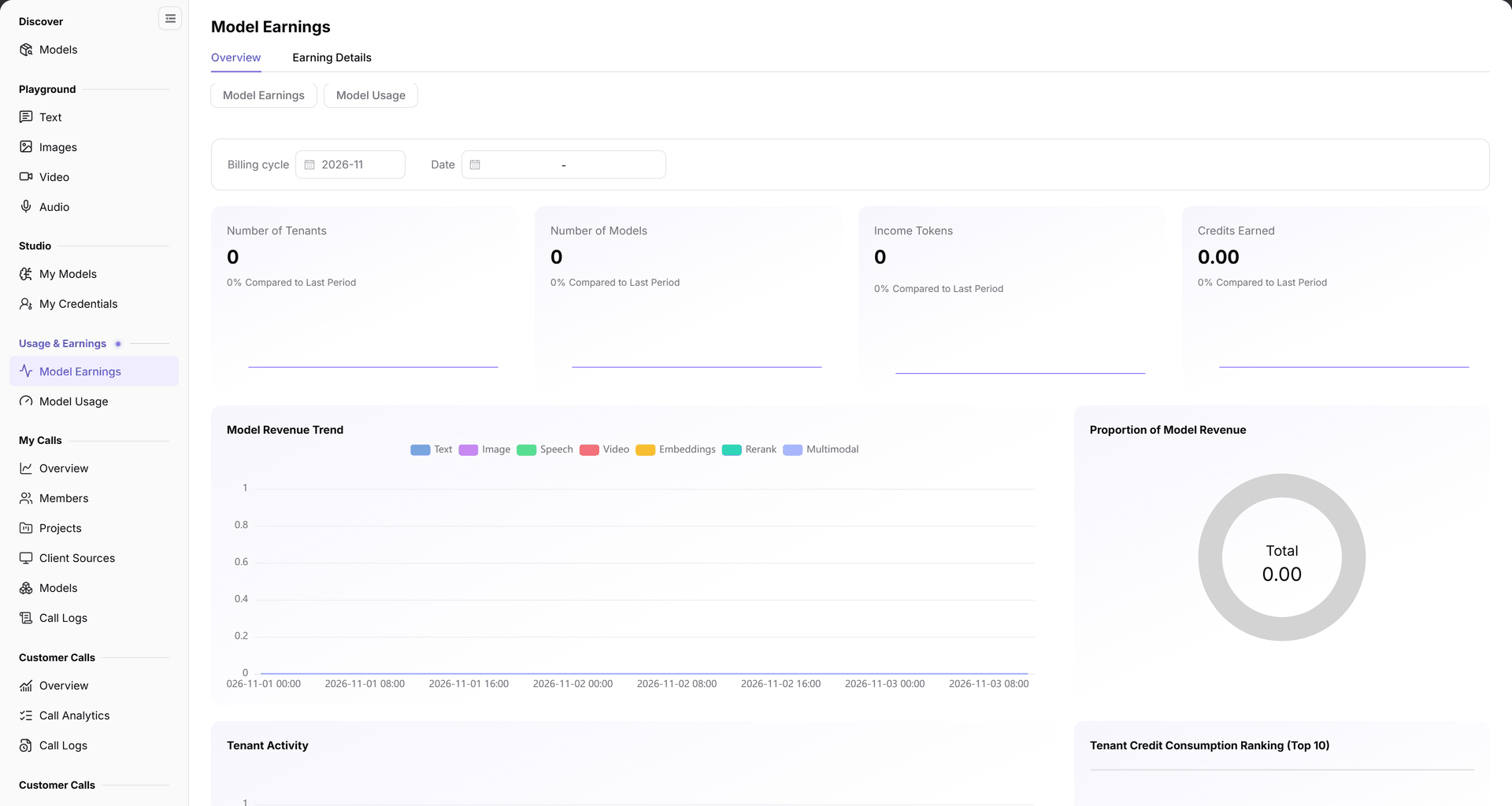
The figure shows provider income. These metrics and caller consumption have different scopes and must be read separately.
- When customer traffic needs checking, the provider uses Customer Calls and Customer Call Logs within its permission scope for the same model and period.
- If values need investigation, the provider checks the effective revision, billing unit, price, and limits in My Models, then hands specific records to the operator. Do not infer universal billing rules for failed or canceled requests from summary totals.
Completion Checklist
| Check | Pass Criteria |
|---|---|
| Scope | Account, model/provider, cycle, dates, and unit are aligned. |
| Calls | Target logs are traceable; route, caller, source, and status are checked separately. |
| Consumption and income | Each overview/detail pair is read in its own scope rather than treated as identical. |
| Differences | Specific records, period, and price evidence can be handed over without credentials. |
Troubleshooting
| Symptom | Check First and Continue |
|---|---|
| Usage is empty | Check period, dates, and actual calls in Model Usage. |
| Earnings are empty | Check period, dates, and model pricing in Model Earnings. |
| Log is missing | Check month, source, and result category in Call Logs. |
| Usage and earnings differ | Align role and statistical scope before checking effective prices. Hand unexplained differences to operators rather than immediately declaring a billing defect. |